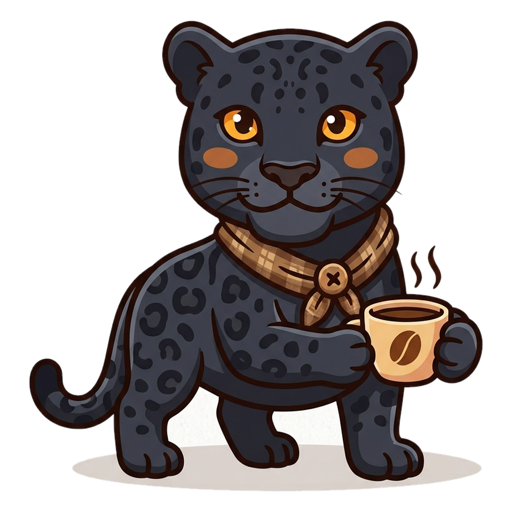
Jaguar
DFCE
Sharp bitterness and powerful body awaken wild instincts.
Recommended OriginBrazil / Ecuador
Personality
Like a jaguar prowling alone through the deep Amazon rainforest, sharply sizing up its prey, you're a bold explorer who seeks out powerful, intense flavors and isn't afraid to chase them down. You trust your own instincts rather than following the crowd, which is exactly why you're willing to take a chance on a bold, unheralded bean nobody else rates yet. Quiet but fiercely focused, once something strong catches your interest you dive in deep -- a trait that mirrors the dark, sharp, bittersweet power of a great Brazilian coffee.
Coffee Preferences
At the heart of your palate is the deep bitterness -- think nuts and dark chocolate -- and the full, weighty body that Brazilian coffee is famous for. Rather than smoothing things out with sweetness, you're drawn to cups where sharp, forceful bitterness and a solid backbone of body show up together. Dark roasts pulled as espresso or brewed in a French press bring out that intensity best, and you savor the long, sharp finish that lingers after the last sip. A bold, hard-hitting cup is what really moves you.
- Dark roast leaning
- Full body
- Crisp leaning
- Explorer
Tips for Enjoyment
Start by comparing dark-roasted Brazilian and Ecuadorian beans side by side. Brazil's nutty power and Ecuador's clean acidity and floral brightness—even with the same dark roast, the character differs by origin. Brew as espresso to taste the contours of bitterness, and vary extraction time and grind size to study how sharpness emerges, deepening your enjoyment of dark roasts even further.
About Your Recommended Origin
Brazil
Brazil is the world's largest coffee producer, with vast, gently rolling highlands spreading across the Cerrado region of Minas Gerais and the southern Minas area. The relatively gentle terrain at roughly 800 to 1,200 meters is well suited to large-scale mechanized harvesting, and a clearly defined dry season is ideal for drying cherries naturally on the tree or on patios. Combining enormous farmland with modern agricultural technology gives Brazil an unmatched scale advantage, delivering both consistent quality and abundant volume.
Natural (dry-process) and pulped natural methods dominate, with cherries dried while still holding their fruit pulp, building sweetness and a thick body. The cup shows a gentle sweetness reminiscent of chocolate, nuts, and caramel, paired with a low, rounded, understated acidity. This smooth, low-intensity character makes Brazilian coffee an ideal base for espresso and blends, an indispensable staple for roasters around the world.
Ecuador
Ecuadorian coffee is grown in the Andean highlands of the southern Loja province and the Intag Valley. Cultivated at extremely high altitudes of 1,600 to over 2,000 meters, the cherries ripen slowly, concentrating delicate flavors. Production once shrank as cacao took precedence, but recent years have seen a specialty revival led by small-scale growers carefully cultivating Typica, Bourbon, and Caturra.
Washed processing dominates, producing a clean, transparent cup. The cup offers floral aromatics, a delicate citrus acidity, and a clear, tea-like finish, with a lighter body than Colombia's. Production remains small and international recognition is still developing, but this very delicacy has been steadily raising the origin's profile.